Mumia
is still in medical danger. He is weak, in the infirmary, and still
needs a wheelchair to come out to visits. In a phone call on Monday his
voice was hesitant and lacked its usual vibrancy. Yesterday, the PA Department of Corrections notified Mumia’s Attorney Bret Grote (of the Abolitionist Law Center) that it would:
Not allow Mumia to be examined by his own doctor;
Not allow Mumia to be examined by a endocrinologist (diabetes specialist);
And they denied access for the doctor to communicate with prison medical staff to assist or direct Mumia’s care; and the Prison
has refused to provide for regular phone calls between Mumia and his
doctor. Currently, Mumia can only use the phone every other day for only
15 minutes, as the infirmary does not have phone access.
Mumia
is being held in the very infirmary that caused his chronic conditions
of eczema and late-onset diabetes to become life-threatening.
The medical personnel on site were prevented from ordering tests when
he was ill in mid-March, and are under the same prison/corporate
restrictions today. One postive note, at this time Mumia is being
allowed to monitor his own blood sugar multiple times a day, and he is
receiving insulin. Since Mumia was hospitalized in ICU on March 30th with
life threatening complications from chronic conditions we have been
advocating for his treatment. We have to step up our efforts.
Take Action Now!
Demand that the Department of Corrections permit Mumia to have an examination by his doctor! Click here to call and fax the Prison and State officials and state our demands.
Pam Africa, Abdul Jon, and Johanna Fernandez visited with Mumia at SCI Mahanoy.
We have 11 days left to reach $40,000 for Mumia
In just 20 days, 465 supporters from around the world have defended Mumia's life by raising $24,837! Now, with 11 days left, we need to reach $40,000 to get Mumia the care he critically needs!
Have you given yet? Now is the time.
We are pursuing every step necessary to get a medical care team to see Mumia.
Please join us by
helping Mumia’s medical fund reach $40K now! We're asking you to
contribute $1,000, $250 or even $8 to the medical fund that will save
Mumia's life. bit.ly/rise4mumia#DefendMumiasLife
The father of Afrofuturism and onetime local is having a big influence on six artists’ upcoming projects. What gives?
By Matthew Hendrickson
Published April 30, 2014
The artist Nick Cave models a Sun Ra-influenced Soundsuit on March 20Photo: Brian Sorg
May marks the centennial of the birth of Herman Blount, the father of
Afrofuturism. Born in Alabama, Blount moved to Chicago in 1946, claiming
that aliens from Saturn had told him to quit school and take up music.
He changed his name to Sun Ra, and by the 1970s he was at the helm of a
cultural movement that was a bizarre concoction of science fiction,
African American history, magical realism, and free jazz. Twenty years
after Blount’s death, interest in Afrofuturism is surging.
“Part of what’s appealing about Sun Ra to artists is the fact that he
was not constrained to a single medium,” says John Corbett, co-owner of
Corbett vs. Dempsey, a gallery in Wicker Park that collects Blount’s
early work. “[It’s] a sensibility that’s very current.”
To meet six innovative Chicago artists with new projects influenced by Sun Ra, see below.
The Guru
Sun Ra, 1914–1993
Photo: Chris Felver/Getty Images
Six Other Afrofuturism Acolytes Worth Checking Out
The Sax Man
David Boykin, 44
Photo: Scott Strazzante/Chicago Tribune
On any given Sunday, you can find multi-instrumentalist David Boykin
jamming with other free-jazz aficionados at the University of Chicago
Arts Incubator in Washington Park. “Sun Ra was among some of the first
records I heard, it was totally an awakening,” says the Greater Grand
Crossing musician who started playing jazz in college. “[Sun Ra’s] music
always sounded like it was happening right now. No one else sounded
like that.” On Sun Ra’s birthday, May 22, Boykin plans to invite 100
saxophone players to salute to the musician at the Arts Incubator (301
E. Garfield Blvd.). They’ll kick things off with “Happy Birthday,”
naturally.
The Performance Artist
Nick Cave, 55
Photo: Ratko Radojcic
Walking into Nick Cave’s South Loop studio—a behemoth of a loft
littered with piles of branches, neon-dyed hair, and thousands of
vintage tchotchkes—is like entering a wacky, warped world that is at
once tribal and futuristic. Famous for his wearable Soundsuits (opulent
assemblages that are part sculpture, part dance performance), Cave has
long said he culls inspiration from Sun Ra’s eccentric rhythms and
choreography. “I think we just need to keep everything funky and keep it
moving,” says the artist, who, like Sun Ra, often performs in costumes
that play off ritual African dress. Cave will perform on May 2 in
Millennium Park at the School of the Art Institute’s annual fashion
show. For tickets, saicfashion.org.
The Rapper-Writer
Lupe Fiasco, 32
Photo: Paul A. Hebert/Invision/AP
This South Side hip-hop artist known for polarizing public appearances
is also a burgeoning author. Last December, he began writing a
noir-Afrofuturist novel on Twitter about Teriyaki Joe, a Harlem
detective. The blaxploitation–meets–Double Indemnity project
has 1.3 million followers, who get frequent updates such as “.45 on the
desk. Digital cigar burning. Sun-Ra coming out the speakers. Antique
Rick Ross poster on the wall.” The account is private, so you’ll have to
request access to @LupeFiasco.
The Sound Artist
Jamal Moss, 40
Photo: Celeste Sloman
A musician who uses the stage name Hieroglyphic Being, Jamal Moss has
recorded over 300 experimental electronic tracks and outlined another
3,000, all rich with spiraling, atonal melodies inspired by Sun Ra’s
1967 album Strange Strings. In March, Moss recorded an album
with Marshall Allen, the sax player who has led Sun Ra’s band, the
Arkestra, since its leader’s death. “[Sun Ra] stuck to his guns . . . no
matter how many people might have ridiculed him,” says Moss, whose new
untitled record is set to hit the shelves this fall. “He carved a niche
for himself on this planet.” For a taste of Moss’s music, hear the song “A Synthetic Love Life.”
The Guitarist
Jeff Parker, 47
Photo: Jim Newberry
This seasoned avant-garde guitarist and backbone of the band Tortoise says the 1970 album My Brother the Wind
“opened my mind to a lot of experimental stuff.” His side project
Isotope 217 also pays homage to Sun Ra with a noisy synth-heavy sound
that Parker says is influenced by the Afrofuturist’s 1974 film Space Is the Place.
“He is a very important musician to me conceptually, just in terms of
having a more metaphysical, spiritual connection through your music. . .
.[Afrofuturism] is a cultural reflection of what African Americans are
dealing with in their art.”
The Filmmaker
Cauleen Smith, 46
For this Kenwood artist and experimental filmmaker, inspiration struck
while standing in line at the DMV. “There was one song in particular,
called ‘Love in Outer Space.’ I just listened to it over and over and
over. I was like, I should be wanting to kill myself right now, but I
feel great,” says the artist. Smith became a Sun Ra scholar of sorts and
has spent the past four years knee-deep in his archives at the
University of Chicago and the West Loop gallery Threewalls. Recently,
she has been weaving his writings on American politics and the black
diaspora into multimedia installations, including the one on view at the
McKinney Avenue Contemporary in Dallas through May 3. Bonus: Here’s a behind the scenes look at the photo shoot with Nick Cave, as he tries out the Soundsuit in our lead photo.
Marvin X and Sun Ra at Marvin X's Black Educational Theatre, Fillmore District, San Francisco, 1972. Sun Ra and Marvin X both lectured in the Black Studies Department, University of California, Berkeley during this time. Marvin performed coast to coast with Sun Ra's Arkestra, reciting his poetry. Sun Ra arranged the musical version of Marvin's play Flowers for the Trashman, retitled Take Care of Business. They produced a five hour concert at San Francisco's Harding Theatre, with a cast of fifty, including the cast of TCB, Arkestra, Ellendar Barne dancers, Raymond Sawyer Dancers.
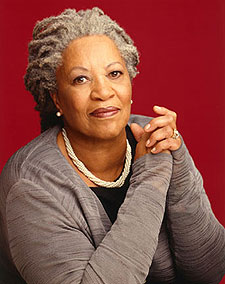
Acclaimed novelist Toni Morrison, while promoting her new novel God Help the Child,
proved that she’s certainly not insulated from the racial climate in
America. Morrison has often written about race, and explained in The Telegraph why she’s grown tired of people who keep calling for a conversation on race.
.
“People keep saying, ‘We need to have a conversation about race,’”
she explains. “This is the conversation. I want to see a cop shoot a
white unarmed teenager in the back,” Morrison says. “And I want to see a
white man convicted for raping a black woman. Then when you ask me, ‘Is
it over?’, I will say yes.”
Morrison is drawing attention to the disparity of how blacks are
policed in comparison to other communities. Recently a black man in
South Carolina was fatally shot in the back as he fled a police officer.
The officer wasn’t arrested until video of the incident surfaced.
Morrison explained during the interview that we’re having a hard time getting past racism because there’s so much money in it.
“Race is the classification of a species. And we are the human race,
period. But the other thing – the hostility, the racism – is the
money-maker. And it also has some emotional satisfaction for people who
need it.” She explains that slavery “moved this country closer to the
economy of an industrialized Europe, far in advance of what it would
have been.”
In a separate NPR interview, Morrison discussed why categorizing people by skin tone is problematic.
“Distinguishing color — light, black, in between — as the marker for
race is really an error: It’s socially constructed, it’s culturally
enforced and it has some advantages for certain people,” she says. “But
this is really skin privilege — the ranking of color in terms of its
closeness to white people or white-skinned people and its devaluation
according to how dark one is and the impact that has on people who are
dedicated to the privileges of certain levels of skin color.”


 Marvin X and Sun Ra at Marvin X's Black Educational Theatre, Fillmore District, San Francisco, 1972. Sun Ra and Marvin X both lectured in the Black Studies Department, University of California, Berkeley during this time. Marvin performed coast to coast with Sun Ra's Arkestra, reciting his poetry. Sun Ra arranged the musical version of Marvin's play Flowers for the Trashman, retitled Take Care of Business. They produced a five hour concert at San Francisco's Harding Theatre, with a cast of fifty, including the cast of TCB, Arkestra, Ellendar Barne dancers, Raymond Sawyer Dancers.